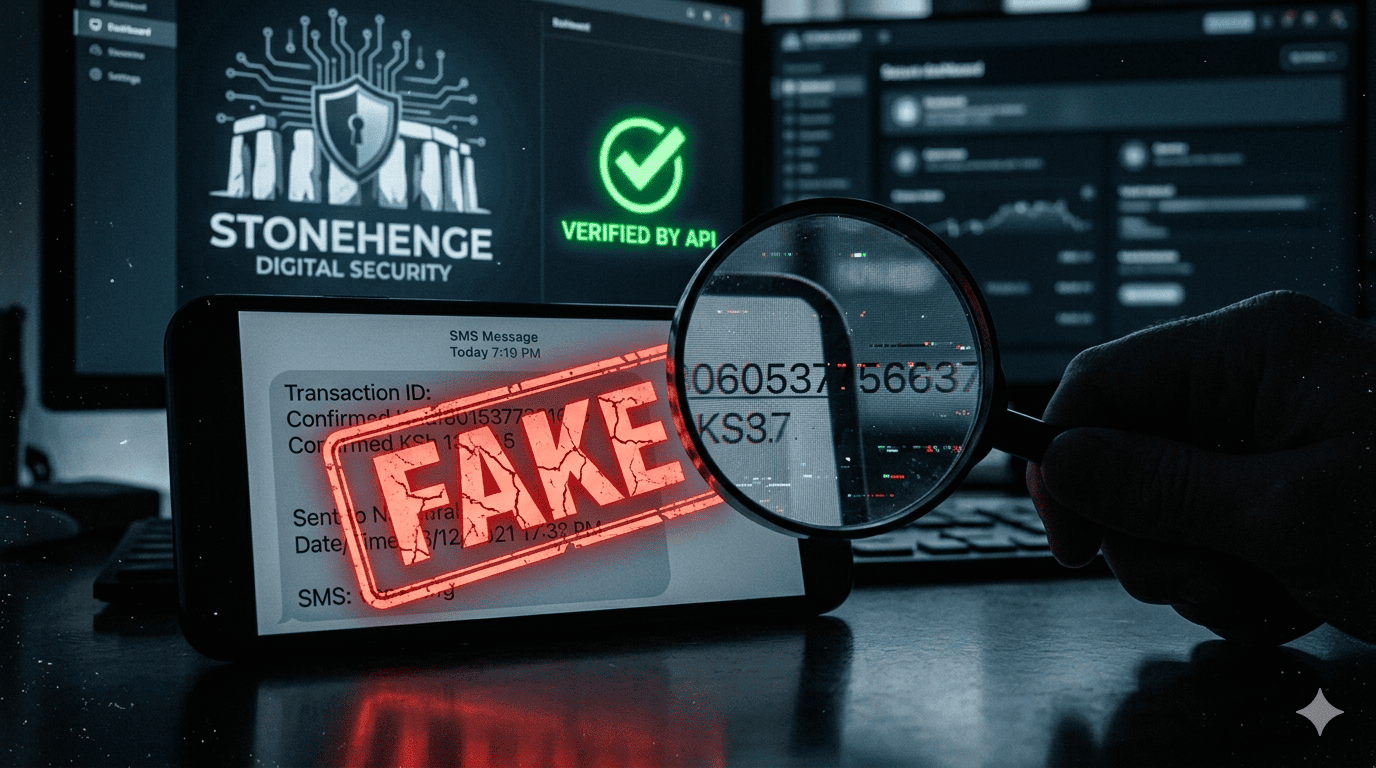
The Dark Side of "Nimetuma" (I've Sent)
You receive a WhatsApp message: "Nimetuma." Attached is a crisp, clear screenshot of an M-Pesa confirmation message showing exactly KES 4,500 sent to your Till. You release the goods to the rider. End of day, you check your statement. The money isn't there.
You've been hit by a fake STK confirmation. Welcome to the frustrating reality of Kenyan e-commerce fraud. While M-Pesa is revolutionary, it has also spawned a cottage industry of sophisticated scammers using fake screenshots, edited HTML, and social engineering.
Here is the Stonehenge Digital guide to protecting your margins.
Fraud Vector 1: The Fake Screenshot
This is the most common. Scammers use apps or simple photo editing to change the amount, date, or recipient name on a real M-Pesa SMS and screenshot it.
- How to Spot It: Check the timestamp. Is it 5 minutes old but the SMS says "Sent on 23rd Jan"? Red flag. Check the font. M-Pesa SMS uses a specific system font. Fake ones often look slightly different.
- Stonehenge Fix: Never trust a screenshot. Our e-commerce dashboard has a "Verify Transaction" button that queries the Safaricom M-Pesa Validation API in real-time. If the API says "Transaction Not Found," the order is held.
Fraud Vector 2: The "Send to Wrong Number" Scam
The scammer sends money to their *own* second number, or a friend's number, but edits the screenshot to show your Till number as the recipient. They then claim "Safaricom is slow" and pressure you to release goods based on the screenshot.
- Stonehenge Fix: Strict policy: "Goods are released ONLY upon system confirmation of payment receipt in our dashboard." If it's not in the dashboard, it didn't happen.
Fraud Vector 3: The M-Pesa Reversal (Fuliza/Overdraft Abuse)
A user pays via STK Push. You see the money in your till. You release goods. Two hours later, Safaricom reverses the transaction because the user was using an overdraft facility (Fuliza) that had reached its limit, or the transaction was flagged for fraud.
- Stonehenge Fix: For high-value items, we recommend a 30-minute "Funds Settlement" hold period. This allows Safaricom's systems to fully clear the transaction. We display a friendly message to the customer: "Payment received! We are preparing your order for dispatch within 30 minutes."
Fraud Vector 4: The Friendly Fraud Chargeback (Card Payments)
If you accept cards (Visa/Mastercard), a customer can pay, receive the goods, and then call their bank and claim: "I didn't authorize this transaction." The bank forcibly removes the money from your account (Chargeback) and you also pay a penalty fee.
- Stonehenge Fix: 3D Secure 2.0 Enforcement. We configure card gateways to require the customer to enter a One-Time Password (OTP) sent by their bank. This shifts liability from the merchant to the bank. If the OTP is entered, the bank cannot claim it was unauthorized.
- Delivery Confirmation: For deliveries, our driver app captures a signature and GPS location. This is evidence in a chargeback dispute.
The Golden Rule of Kenyan E-Commerce Fulfillment
Train your staff on one unbreakable rule: "Dashboard First. Screenshot Never." The 5 minutes it takes to verify is cheaper than losing the cost of goods and delivery.
Interested in E-Commerce Website with M-Pesa?
Let's build this for your business
Sell to any Kenyan with a phone. Full online shop with Safaricom STK Push payment — no card needed.
10 Comments
Mama Jimmy (Baby Clothes)
25 Apr 2026
I got scammed like this in 2024. Lost KES 8,000 worth of clothes. I was so embarrassed. I only trust the dashboard now. This article is a public service announcement.
The Tech Guy (Nairobi)
25 Apr 2026
The "30-minute settlement hold" is a great practice but hard to enforce with customers who want instant pickup. "Why can't I take my shoes now? I paid!" It creates customer service friction. I'd love to see a follow-up article on how to communicate this hold period without making the customer feel like you're accusing them of being a scammer. Maybe phrasing it as "Safaricom security verification period" shifts the blame to the network, not the customer. "Due to recent fraud attempts, Safaricom requires a short 20-min verification window on all first-time orders." That might work.
Akinyi O.
25 Apr 2026
The 3D Secure for card payments is a MUST. I got hit with a KES 15,000 chargeback last year because I didn't have OTP enabled. Never again.
Brian S.
25 Apr 2026
"Dashboard First. Screenshot Never." I'm printing that and putting it above my packing station.
Wanjiku N.
25 Apr 2026
The font check is a good tip, but the scammers are getting better. The API verification is the only real solution. If you're relying on screenshots, you're gambling.
Kevin O.
25 Apr 2026
What about the fake Till Number SMS that looks like it's from Safaricom but has a different number? Like a "Confirmation" from a shortcode that isn't MPESA. Watch out for those too.
Grace M.
25 Apr 2026
I had a customer send a fake screenshot of KES 5,000 on a KES 500 item just to see if I'd give them KES 4,500 "change." Some of these scammers are bold.
Otieno R.
25 Apr 2026
The Fuliza reversal is a new one for me. I didn't know Safaricom could reverse a completed STK push. That's a scary thought. I'll implement the hold period for high value items.
Faith J.
25 Apr 2026
Does Stonehenge offer a service to train our staff on fraud detection? Because the tech is one part, but the human element is the weakest link.
James K.
25 Apr 2026
Great write-up. Fraud prevention is part of the cost of doing business online in Kenya. Better to spend on prevention than on losses.