The Daily "Guesstimate" That's Costing You
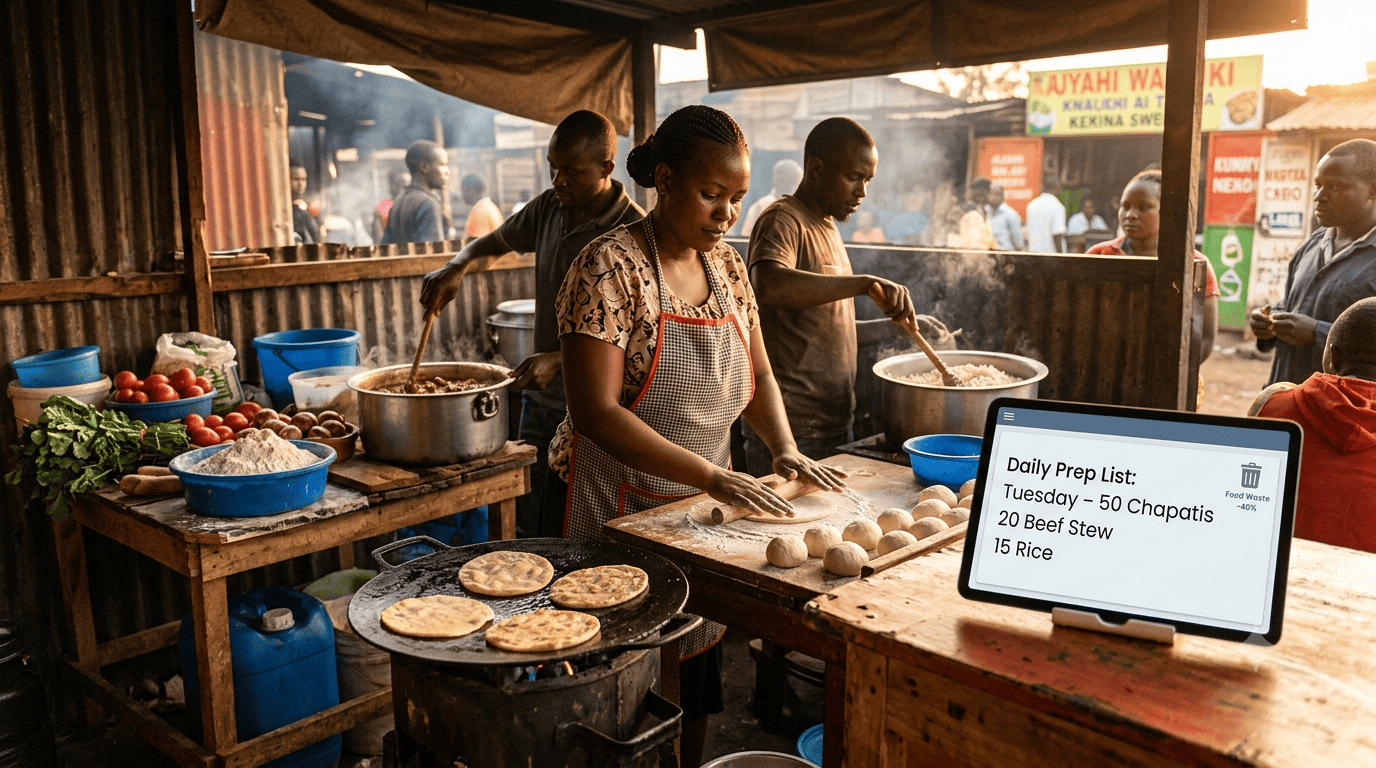
Every morning, Mama Akinyi, who runs a small food kiosk (kibandaski) in Industrial Area, faces the same question: "How many chapatis should I make today? How much beef stew? How much rice?" She guesses. Some days, she runs out by 1 PM and turns away hungry customers. Other days, she throws away unsold food worth KSh 800 at closing.
Then she started using a simple dashboard that analysed her last month's sales by day of the week. It told her exactly how many portions of each dish she sold on, say, an average Tuesday. She started using that data as her prep list. Her food waste dropped by 40%, and her stock-outs dropped significantly too.
Guessing Daily
- Prepping based on "gut feel"
- Running out of food by 1 PM
- Throwing away KSh 800 daily
- Turning away hungry customers
- No idea where the money goes
Data-Driven Accuracy
- Prepping based on historical sales
- Knowing Tuesday needs 45 chapatis
- Waste cut by 40%
- Meeting customer demand exactly
- Saving thousands monthly
How the "Smart Prep List" works
Four steps to move from chaotic mornings to a precise, profitable operation.
1. Record Daily Sales by Item
Mama Akinyi uses a simple POS (even a tablet with the Stonehenge Digital dashboard) to record every sale: 2 chapatis, 1 beef stew, 1 rice. She does this for a month.
The Foundation Consistent data entry builds the blueprint for your prep list.2. Run the "Sales by Day of Week" Report
The dashboard generates a clear table showing averages for each day. It reveals patterns that were previously invisible, such as the Friday rush or the Saturday slump.
The Insight You stop guessing and start preparing for the exact demand of the day.3. Generate the Daily Prep List
On Tuesday morning, the dashboard tells her exactly what to prep. She preps to the higher end of the range to allow for a slight buffer, but does not wastefully over-produce.
The Action "Prep: 45-50 chapatis, 18-20 beef stew portions, 12-15 rice portions."4. The "Special Day" Override
The dashboard also allows her to input "special factors" that adjust the baseline. End-month (workers have money) might mean an increase of 15%. Rains expected might mean a decrease of 10%.
The Flexibility Data gives you the baseline, but you remain in control of the real-world variables.What the data actually looks like
This simple table replaced Mama Akinyi's daily guesswork. It takes the emotion and uncertainty out of food preparation.
| Day | Chapatis (Avg) | Beef Stew (Avg) | Rice (Avg) |
|---|---|---|---|
| Monday | 50 | 20 | 15 |
| Tuesday | 45 | 18 | 12 |
| Wednesday | 60 | 25 | 20 |
| Thursday | 55 | 22 | 18 |
| Friday | 70 | 30 | 25 |
| Saturday | 35 | 12 | 10 |
From Waste to Profit
Food waste dropped from an estimated KSh 800 per day to KSh 400. That is KSh 12,000 saved per month. Her stock-outs reduced, increasing revenue by an estimated KSh 5,000 per month. The net monthly improvement was around KSh 15,000, which is enough to hire an extra pair of hands.
Cooking too much wastes money. Cooking too little turns away paying customers. Neither is good for business.
Stop guessing how much to cook. Let your sales data tell you.
Ready to build your smart prep list?
Stonehenge Digital builds business management systems with daily sales tracking, day-of-week reports, and automated prep suggestions, so your kitchen runs on data, not guesswork.
Build My Smart Prep List →Interested in Business Management System?
Let's build this for your business
Replace spreadsheets, paper records, and WhatsApp chaos with a custom system built for exactly how your business works.