The Questions Are Always the Same
Every corporate or NGO buyer who lands on your website eventually has the same set of questions. If they have to email you to get these answers, you have just added 3 to 5 days to your sales cycle, and risked them moving on to a competitor whose website already answers them.
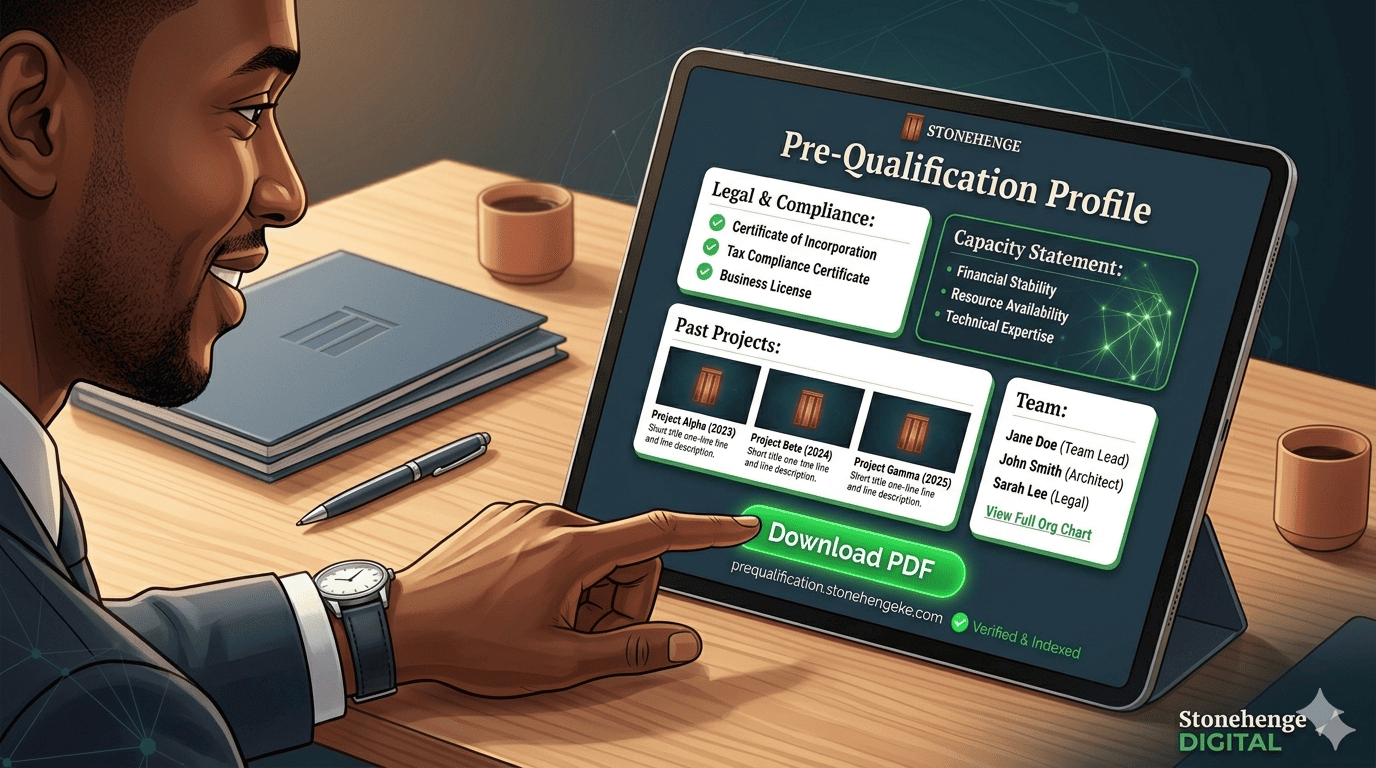
A "Pre-Proposal" page is a single destination on your site that proactively answers every common procurement question. It is like a pre-filled vendor registration form, built into your website.
The Slow Path
- Buyer emails to ask for KRA PIN
- You reply 2 days later
- Buyer asks for project examples
- You send a PDF attachment
- 7 days pass before a real conversation
The Fast Path
- Buyer lands on one page
- Answers are already there
- They download the PDF and attach it
- They self-qualify before contacting you
- 2 days from inquiry to proposal request
The five questions every buyer asks
These are the questions that sit in the mind of every procurement officer, NGO manager or corporate buyer before they make contact.
- "Are you legally registered in Kenya?"
- "What is your KRA PIN and tax compliance status?"
- "Have you done similar work before? Show me proof."
- "What is your typical project timeline and pricing range?"
- "Who are your key team members and what are their qualifications?"
How to structure a Pre-Proposal page
Five sections, each one removing a specific doubt from the buyer's mind.
Section 1: Legal and compliance profile
Company Registration Number, KRA PIN, Tax Compliance Certificate if current, physical address, and a note on your data protection practices. Make this section scannable, almost like a table.
Section 2: Capacity statement
One paragraph on what your firm does, who you serve, and your core capabilities. Then, a table of past relevant projects, anonymized if needed, with client sector, scope, duration, budget range and outcome. This is the proof section.
"Client: Tier-1 Kenyan bank | Scope: Internal audit restructuring | Duration: 14 weeks | Budget: KSh 1.2M | Outcome: 32% reduction in audit cycle time."Section 3: Methodology and approach
A simple 3 to 4 step outline of how you typically execute projects. It does not need to be proprietary. It just needs to show you have a structured process, not a chaotic one.
Section 4: Team qualifications
A mini version of your team page, with key personnel and their relevant certifications such as ICPAK, AAK or PMP. The buyer needs to know who will actually do the work.
Section 5: Pricing indication
If you can, give a range. This filters out budget mismatches early and saves everyone time. You do not have to commit to a precise number to be useful.
"Typical projects of this scope range from KSh 500,000 to KSh 1.2M depending on complexity."The "Download as PDF" button
One Click to the Shortlist
At the top of the page, add a prominent button that generates a clean, branded PDF. The buyer can attach it to their internal evaluation form. You have just become the easiest supplier to evaluate.
The impact on your sales cycle
From 7 Days to 2 Days
One of our clients, a training consultancy, reported that after implementing a Pre-Proposal page, the average time from initial inquiry to proposal request dropped from 7 days to 2 days. Buyers had already self-qualified before they made contact.
Stop writing the same email responses over and over. Build a page that answers the questions for you, 24/7.
The easiest supplier to evaluate is often the one who gets the contract.
Ready to build your Pre-Proposal page?
Stonehenge Digital builds organisational websites with pre-proposal pages, downloadable compliance packs and structured vendor profiles, designed to shorten your sales cycle and win more tenders.
Build My Pre-Proposal Page →Interested in Portfolio & Organisational Website?
Let's build this for your business
A professional, mobile-first website that makes your business look credible and gets found on Google.