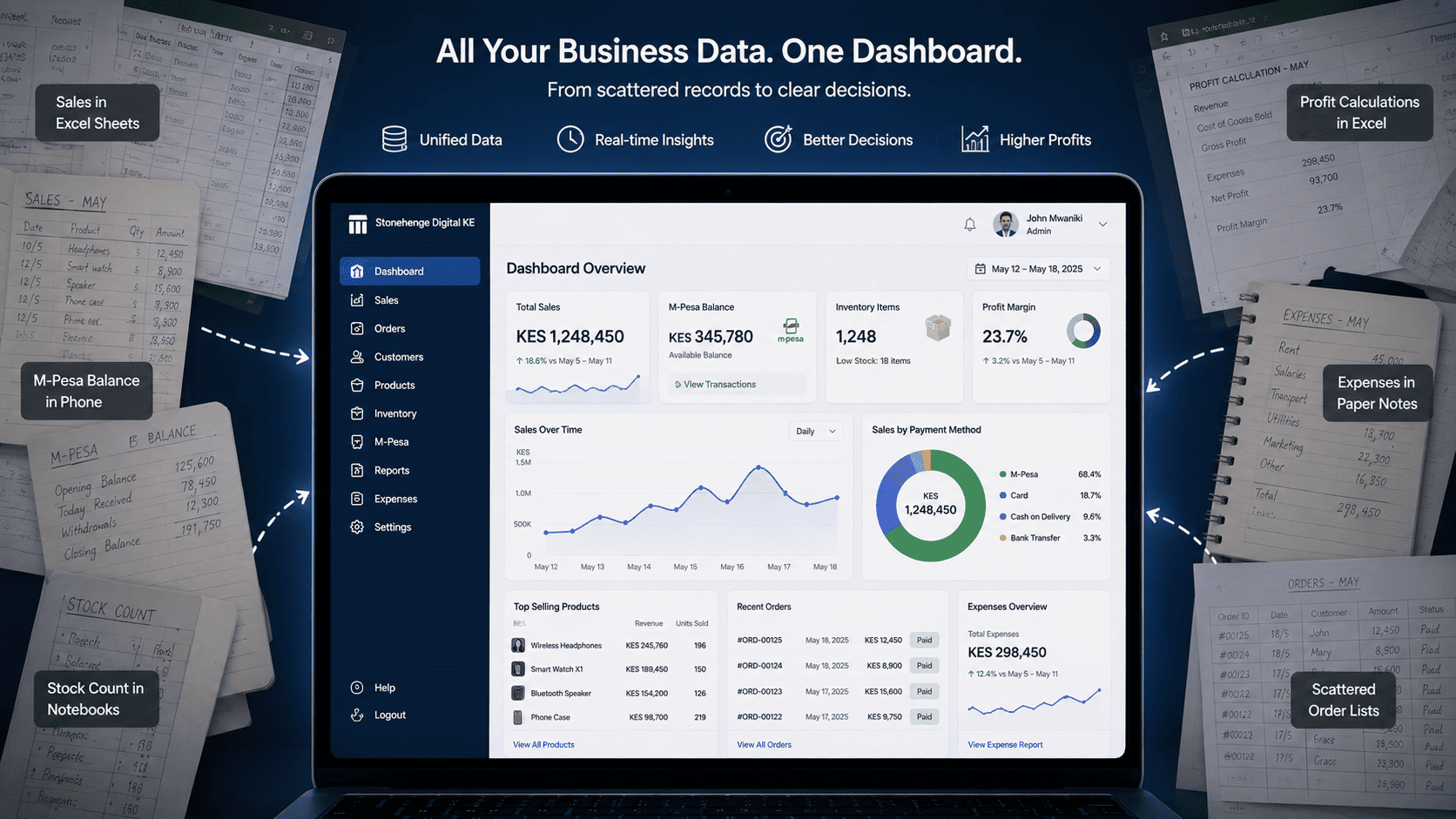
The Three Version Problem
The sales notebook says one thing. The Excel sheet says another. The M Pesa statement says a third. Which number do you trust?
When it is time to make a decision, how much stock to order, whether to hire, what your margin actually is, you are unsure which number to trust. This is data chaos, and it is slowly killing your business.
How many versions of the truth do you have
Most businesses do not set out to create conflicting records. They accumulate them, one tool at a time, until nobody can say which one is correct.
Three records, three different answers
Each one is partly right. None of them is the whole picture, and no meeting can be settled by pointing at one of them.
What a single source of truth actually is
A Single Source of Truth dashboard consolidates all your business data into one unified view: sales, expenses, inventory, M Pesa and bank. When there is only one source of truth, decision making becomes faster, clearer and more confident.
How to build a single source of truth
Identify your core data streams
List the key data sources in your business. These are the streams that must feed into the dashboard, and the ones that must stop feeding anything else.
Sales, from the point of sale. Mobile money, from M Pesa or Pochi. Bank, from statements or feeds. Inventory, from stock records. Expenses, from receipts and payments.Automate data ingestion where possible
Connect the dashboard to these sources through APIs where available. For M Pesa, use the Safaricom API to import transactions automatically. For the bank, use bank feeds if they exist. The less manual entry, the fewer errors.
A single automated feed removes the person who "sometimes forgets" to update the sheet.Standardise definitions
Make sure everyone in the business agrees on what each term means. Clear definitions prevent two departments from reporting the same metric with different numbers, in good faith.
Revenue means gross or net. Profit means before or after the owner's salary. Expenses include or exclude owner drawings.Use the dashboard as the only reporting tool
Once the dashboard is live, make it the only place you look for business numbers. No more asking the accountant for a separate report. No more checking a spreadsheet. The dashboard is the truth.
If a number matters, it lives in the dashboard. If it does not, it does not belong in the meeting.The definitions that cause the most arguments
Four terms that must mean one thing
Two honest people can disagree about profit for an hour purely because they are using different definitions. Writing them down ends the argument before it starts.
Scattered reports versus one dashboard
Five places to look
- The notebook behind the counter
- A weekly Excel file
- An M Pesa statement PDF
- The accountant's monthly report
- A separate stock sheet
One place to decide
- Cash position, current
- Profit, defined once
- Stock levels, live
- Sales by period
- Every figure traceable to a source
The peace of mind dividend
You stop second guessing yourself
When you have a single source of truth, you know your cash position, your profit and your inventory levels at any moment. That clarity reduces stress and enables you to make bold, confident decisions.
The real benefit is not the report itself. It is the meeting that takes ten minutes instead of two hours, because nobody needs to argue about which number is right first.
A practical way to start this week
Five steps that cost nothing
- List every place a business number currently lives, including notebooks and WhatsApp threads
- Pick the one metric that causes the most arguments, usually profit or cash position
- Write down the definition of that metric, agreed by the people who use it
- Compare the number across the sources and find out why they disagree
- Decide which source will be authoritative from today, and retire the others
The summary
Stop living in data chaos. Build your single source of truth today.
Start with definitions, then automate the feeds, then make the dashboard the only place you look. The technology follows the agreement. It cannot replace it.
Ready for one number you can trust?
Stonehenge Digital builds business management dashboards that consolidate sales, M Pesa, bank, inventory and expenses into one traceable view.
Build My Single Source of Truth →Interested in Business Management System?
Let's build this for your business
Replace spreadsheets, paper records, and WhatsApp chaos with a custom system built for exactly how your business works.