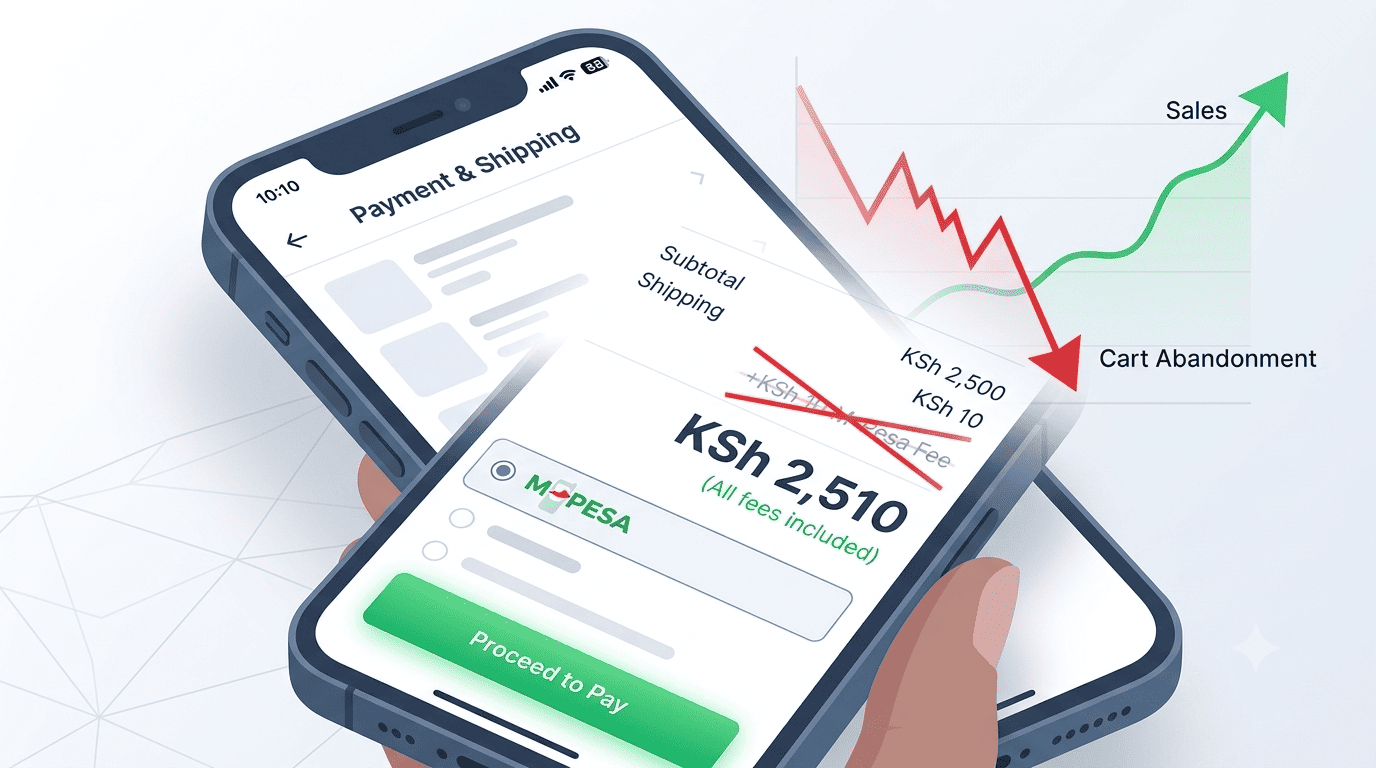
The Silent Cart Killer
Jane sells beautiful handmade sandals online. Her average order is KSh 2,500. To protect her margins, she adds the KSh 10 M-Pesa STK transaction fee to the customer's total at checkout. It seems logical. It is just KSh 10.
What Jane did not realise is that this tiny surcharge was silently killing her sales. Over three months, she lost an estimated KSh 40,000 in abandoned carts, all because of a KSh 10 fee that customers perceived as a "hidden charge."
Risky and Petty
- Adds a separate KSh 10 line item
- Customer feels nickel and dimed
- Sparks suspicion of more hidden fees
- Small fee amplifies the annoyance
- Higher cart abandonment at payment step
Clean and Trusted
- Builds the fee into product price
- Single, clean total at checkout
- No surprise charges
- Customer feels respected
- Higher conversion at the final step
The psychology of the tiny fee
Kenyans are not averse to paying fees, but they are averse to surprise fees and petty charges. When a customer reaches the final step and sees a separate KSh 10 line item, three specific reactions occur.
The "Nickel and Dime" Feeling
This seller is so cheap they cannot even absorb KSh 10? The smallness of the fee actually amplifies the negative perception. A KSh 200 delivery fee feels like a service. A KSh 10 fee feels like a sting.
"If you can't cover KSh 10, I don't trust you with KSh 2,500."The "What Else?" Suspicion
If they are adding KSh 10 here, are there other hidden charges coming? It erodes trust in the total price and makes the customer feel like the checkout is a trap.
"What will the final total actually be?"The "Principle" Abandonment
Some customers abandon not because they cannot afford KSh 10, but because the principle of a surprise surcharge annoys them. It is a matter of respect, not money.
"It's not about the KSh 10. It's about the sneakiness."The data
We analysed checkout data for five Kenyan e-commerce stores that passed on the STK fee versus five that absorbed it.
A KSh 10 Line Item, A KSh 13,000 Loss
The stores that passed on the fee had an 18 percent higher cart abandonment rate at the payment step. Jane's KSh 10 fee was costing her over KSh 13,000 monthly in lost sales, far exceeding the total fees she was saving.
The solution: Absorb and adjust
The smart approach is to absorb the STK fee as a cost of doing business and adjust your pricing strategy accordingly.
Build it into the product price
If your sandals cost KSh 2,500 and the fee is KSh 10, price them at KSh 2,510 or KSh 2,550 and offer all-inclusive pricing. The customer sees a single, clean total.
"Handmade Sandals: KSh 2,550 (delivery and fees included)."Offer a cash discount instead
If you want to encourage lower-fee payment methods, offer a small discount for those, rather than surcharging STK. This feels like a reward, not a penalty.
"Pay via bank transfer and save KSh 50."Do not let a KSh 10 surcharge cost you thousands in lost sales. The fee is not the problem. The visibility of the fee is the problem.
Absorb the tiny fee, adjust your pricing, and keep your checkout clean.
Ready to fix your checkout?
Stonehenge Digital builds e-commerce platforms with clean, all-inclusive pricing, seamless STK Push integration, and conversion-focused checkout design, so a tiny fee never costs you a big sale.
Optimise My Checkout for Higher Conversions →Interested in E-Commerce Website with M-Pesa?
Let's build this for your business
Sell to any Kenyan with a phone. Full online shop with Safaricom STK Push payment — no card needed.