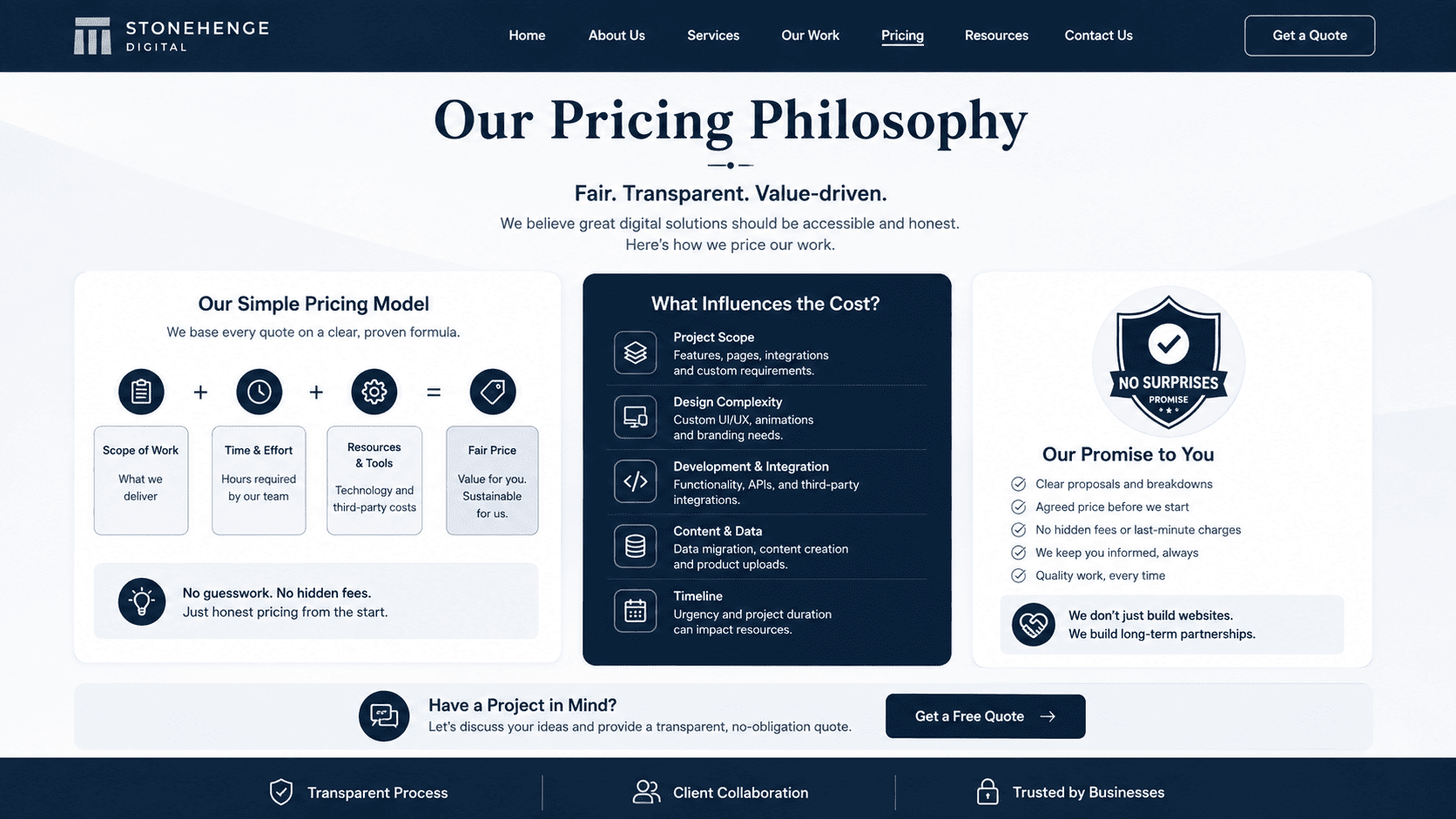
Hiding Prices Creates Suspicion
Most Kenyan professional services, including lawyers, consultants and architects, do not list prices on their websites. The reason is fear: if I show my prices, clients will go to cheaper competitors.
The opposite often happens. Hiding prices creates suspicion: if they are not transparent about money, what else are they hiding?
What the client infers
- No price means no clarity
- Money talk is avoided
- Quotes probably vary by mood
- Hidden fees feel likely
- Comparison shopping gets harder
What the client concludes
- Model explained in plain language
- Cost factors named openly
- A typical range published
- No surprises promise in writing
- Serious prospects self select
What to include on a pricing philosophy page
Your pricing model, in plain English
Do you charge hourly, fixed fee, retainer or a percentage? Explain it simply, and say why you chose it. The reason is often more persuasive than the number.
"We prefer fixed fee engagements because we believe clients should not be penalised for our efficiency. You agree on a price upfront, and we focus on delivering value, not padding hours."The factors that affect cost
List the specific variables that influence a quote. This helps the client understand why quotes vary and positions you as transparent rather than evasive.
"Project complexity, regulatory requirements, and turnaround time."A typical range, if possible
Even a broad range filters out mismatches. A client with a KSh 10,000 budget will not waste your time, and a serious client feels confident you are in their range.
"Typical audit engagements for SMEs range from KSh 80,000 to KSh 250,000 depending on transaction volume and complexity."Your no surprises promise
Commit to something tangible. This directly addresses the client's fear of hidden fees, which is the real reason price hiding feels risky to them.
"If we anticipate the final cost will exceed the agreed estimate by more than 10 percent, we will inform you immediately and seek approval before proceeding."Why a range works better than a number
A published range does two jobs at once, and neither of them is committing you to a price you cannot defend.
The audit example, in practice
"Typical audit engagements for SMEs range from KSh 80,000 to KSh 250,000 depending on transaction volume and complexity."Put the promise in writing
The no surprises commitment is the single most trust building line on the page, because it names the fear directly and answers it with a process.
What the client reads before enquiring
Notice how specific the numbers are. A vague promise to be transparent means nothing. A named threshold with an approval step is a commitment a client can hold you to, and that is exactly why it builds trust.
The competitive advantage
In a market where most firms hide their pricing, being open is a differentiator. It signals confidence, professionalism and respect for the client's time.
Hiding prices does not protect you from cheaper competitors. It tells serious clients that money is a subject you would rather avoid.
Stop hiding. Start explaining. A Pricing Philosophy page could be your most powerful trust asset.
Ready to explain your pricing properly?
Stonehenge Digital builds organisational websites with clear pricing philosophy pages, published ranges and written commitments, so clients arrive confident instead of suspicious.
Add a Pricing Philosophy Page to My Site →Interested in Portfolio & Organisational Website?
Let's build this for your business
A professional, mobile-first website that makes your business look credible and gets found on Google.