Your Portfolio Is Being Scored, Not Just Viewed
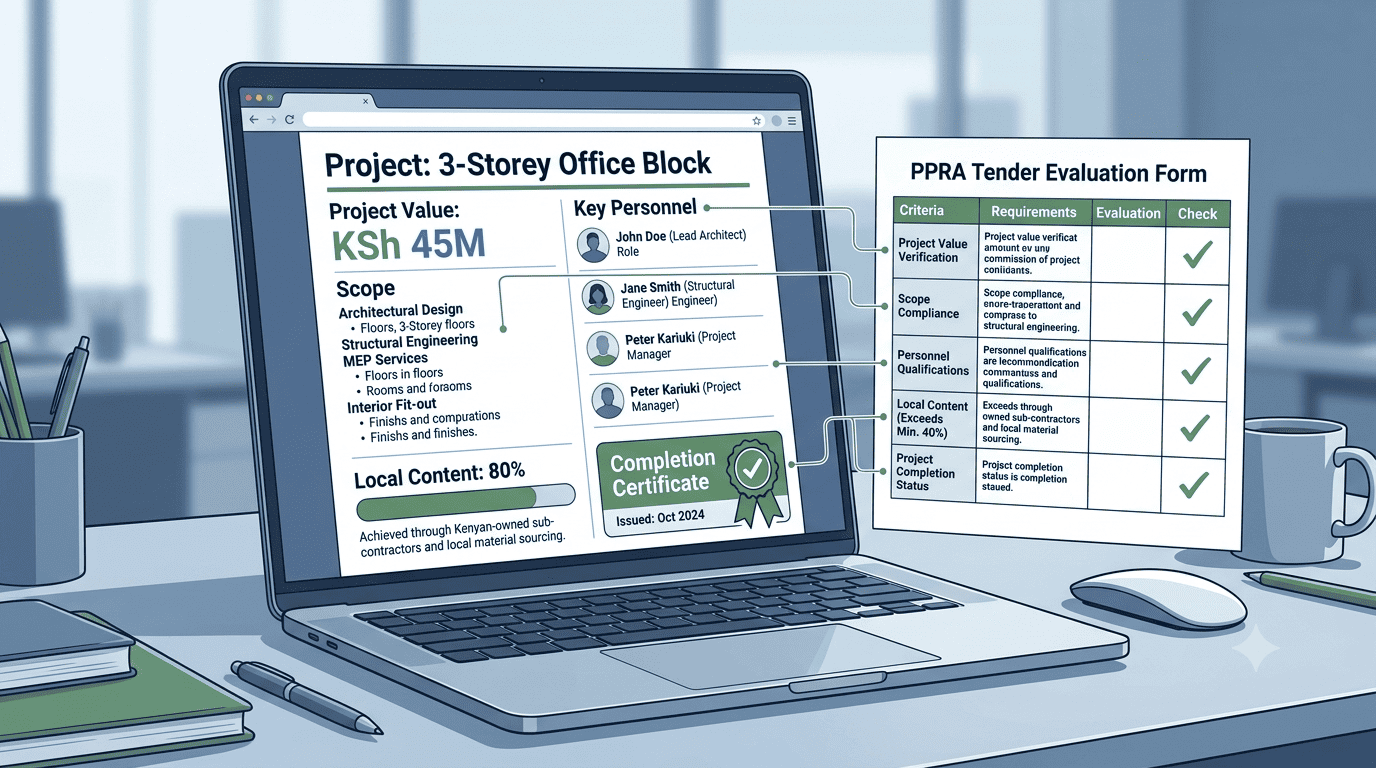
When you submit a tender to a Kenyan government ministry or county, your website is often visited as part of the due diligence, even if you did not include the link. The evaluator opens your "Projects" or "Portfolio" page and mentally scores it against the Public Procurement Regulatory Authority (PPRA) evaluation criteria.
Most SME project pages are just image galleries with vague captions: "Project Alpha - 2024." That scores zero. A well-structured project page that mirrors the PPRA scoring framework can silently add points to your evaluation before you even submit the bid.
Scores Zero
- Photos with no context
- No contract value or duration
- No named personnel
- No mention of local content
- Nothing an evaluator can tick off
Scores Points
- Client type and project value stated
- Duration with on-time completion
- Scope listed in bullet points
- Qualified team named
- Verification available on request
The PPRA-aligned case study template
Seven elements, each mapped to a criterion the evaluator is already scoring. Build every project page this way and the points accumulate quietly.
Project title and client
Name the project and describe the client by type, anonymising only where a confidentiality clause requires it.
"Construction of a 3-Storey Office Block for [A County Government]"Project value and duration
Give the contract value and the actual delivery window, and state plainly whether you finished on time.
"Contract Value: KSh 45,000,000 | Duration: 14 months (Completed on time)."Scope of work
List exactly what you delivered in bullet points. Be specific, because breadth of scope is what demonstrates capability.
"Excavation, reinforced concrete structure, electrical installation, plumbing, finishes, and landscaping."Key personnel involved
Name the people who ran the project, with their professional credentials, and link to their fuller profiles on your team page.
"Project Lead: Eng. Jane Wanjiku (PE, MIEK). Site Manager: Samuel Otieno."Local content and subcontracting
Quantify your local sourcing and name the local firms you subcontracted. This is a significant scoring factor in Kenyan government tenders.
"Sourced 80% of materials from Kenyan suppliers. Subcontracted electrical works to a local Nairobi firm, [Name]."Challenges and solutions
Describe one real obstacle and how you solved it. This proves you can handle the unexpected, which is a form of past performance evidence.
"Encountered unexpected rock during excavation. Implemented a revised foundation design without time delay, approved by the county engineer."Completion certificate or testimonial
State that the project was handed over and accepted, and offer the completion certificate. A short client quote makes it stronger still.
"Project handed over and accepted by the client. Completion certificate available upon request."How this scores you points
When the evaluator reads a page built this way, they are not hunting for evidence. They are ticking boxes that you have already filled in.
You Have Done Their Job For Them
You have made it easy to give you points. And in government procurement, the easiest vendor to evaluate is often the winner.
Your projects page is read as part of due diligence, often without you knowing. Make it a bid document, not a photo album.
Stop posting photo galleries. Start publishing tender-ready case studies. Your projects page is your silent bid document.
Ready to build a tender-ready portfolio?
Stonehenge Digital builds organisational websites with PPRA-aligned project pages, structured case studies and downloadable compliance packs, designed to score points with evaluators before the bid is even opened.
Structure My Projects for Government Scoring →Interested in Portfolio & Organisational Website?
Let's build this for your business
A professional, mobile-first website that makes your business look credible and gets found on Google.