The KSh 500,000 Illusion
You look at your monthly dashboard. Sales: KSh 500,000. You feel good. But when you check your bank balance at month-end, you wonder where all the money went. Not all sales are created equal.
Some products have razor-thin margins; others are profit engines. This tutorial shows you how to calculate gross profit per item and use it to make smarter decisions.
Step 1: Input cost prices for every product
Your dashboard needs two pieces of information for every product: the selling price the customer pays, and the true cost price you paid to acquire the item, including transport and any associated costs.
An incomplete picture
- Product cost from supplier: KSh 1,000
- Transport not included
- Packaging not included
- Looks cheaper than it is
- Leads to margin surprises
What the dashboard needs
- Product cost from supplier: KSh 1,000
- Transport per unit: KSh 50
- Packaging per unit: KSh 20
- Total cost price: KSh 1,070
- Gives you an honest margin
Step 2: The dashboard calculates gross profit
For each sale, the dashboard calculates gross profit using a simple formula.
Example: Selling Price KSh 1,500 - Cost Price KSh 1,070 = Gross Profit KSh 430.
Gross Profit Margin = (Gross Profit ÷ Selling Price) × 100. In this example, that is 28.7 percent.
Step 3: Run the gross profit by product report
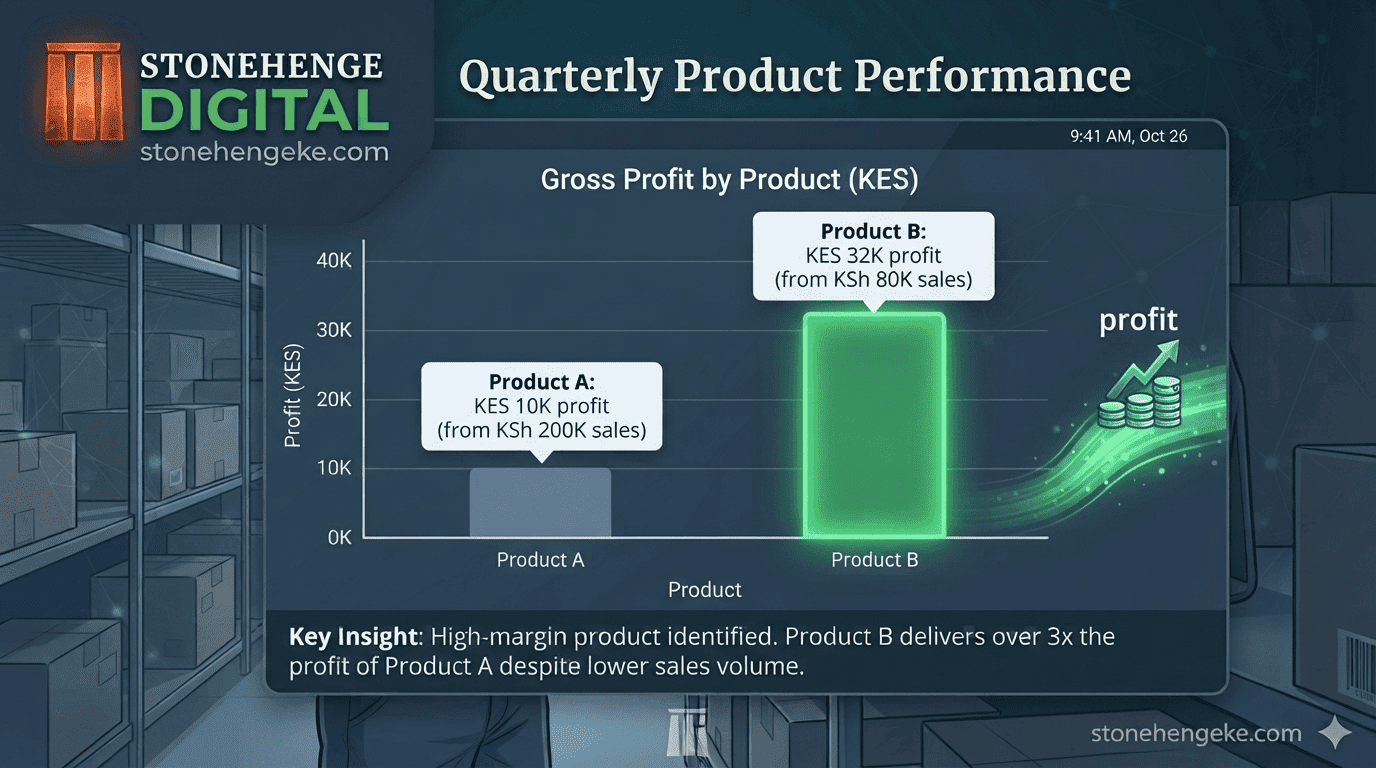
Your dashboard generates a report ranking products by their total gross profit contribution. Here is an example.
| Product | Sales (KSh) | Margin % | Gross Profit (KSh) |
|---|---|---|---|
| Product A | 200,000 | 5% | 10,000 |
| Product B | 80,000 | 40% | 32,000 |
| Product C | 150,000 | 15% | 22,500 |
Step 4: Make decisions based on the data
Promote high-profit items
Product B is your profit engine. Feature it prominently on your website and social media. Bundle it with complementary items. Train staff to recommend it first.
"This is the item that quietly pays the bills. Make it impossible to miss."Re-evaluate low-profit items
Product A has a 5 percent margin. Is it worth the shelf space and cash tied up? Maybe negotiate a better cost price with the supplier. If not, consider dropping it or using it only as a traffic driver.
"A traffic driver brings customers in. Just make sure they leave with higher-margin items."Adjust your product mix
Shift your buying strategy to favour high-margin products. You do not need to drop low-margin items entirely, especially if they are customer favourites, but your overall portfolio should be profitable.
"A balanced mix is not equal sales. It is intentional profit."Step 5: The profit per transaction metric
Beyond individual products, track gross profit per transaction. If your average basket is KSh 2,500 and your average margin is 20 percent, your gross profit per transaction is KSh 500.
The sales is vanity, profit is sanity principle
A high sales number might impress, but profit pays the bills. Gross profit per item is the metric that reveals the true health of your product mix.
Start tracking it, and make decisions that build a profitable business, not just a busy one.
Ready to see your real profit per item?
Stonehenge Digital builds business management systems that calculate true cost prices, track gross profit per product and show you where the money actually goes.
Calculate My Profit Per Item →Interested in Business Management System?
Let's build this for your business
Replace spreadsheets, paper records, and WhatsApp chaos with a custom system built for exactly how your business works.