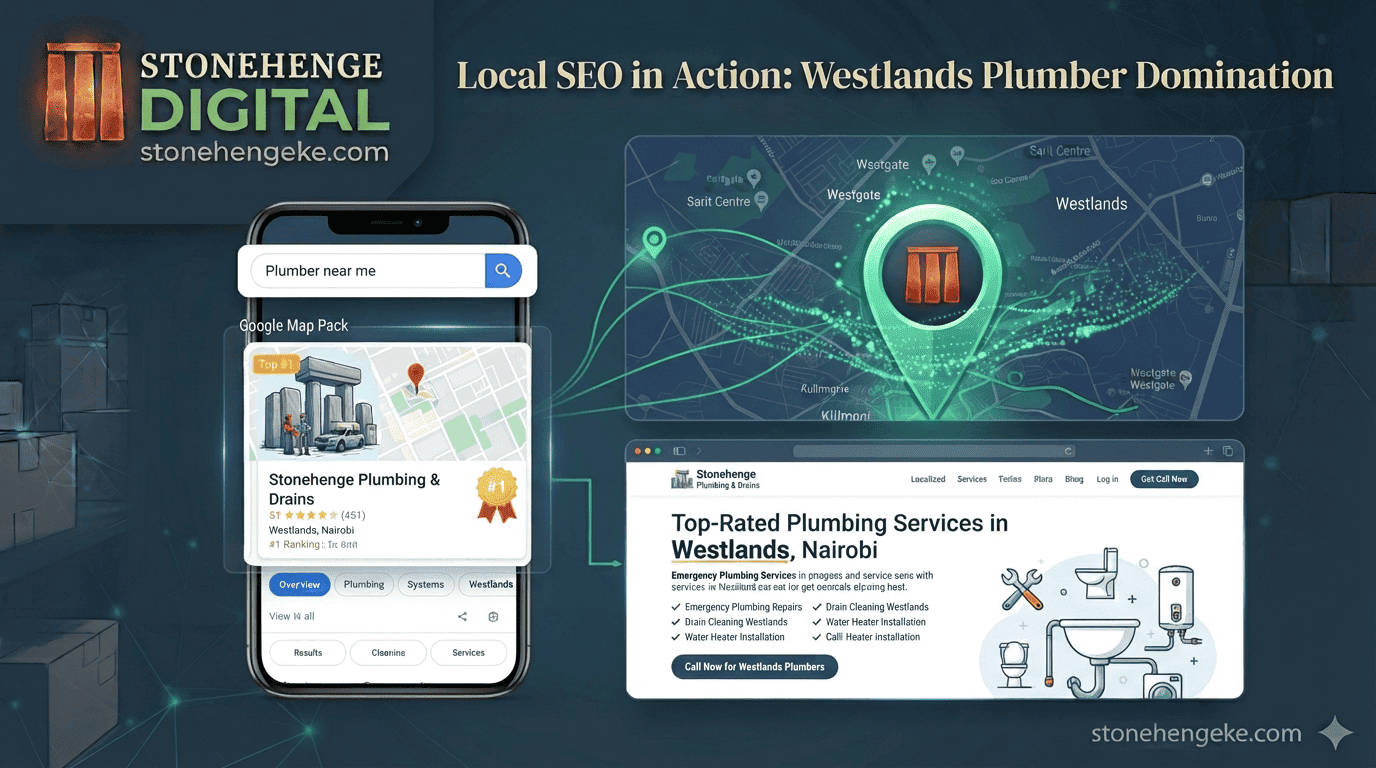
The High-Intent Search
When someone searches "plumber near me" or "accountant in Westlands," they are not browsing. They are ready to buy. This is the highest-intent traffic you can capture.
This tutorial shows you how to rank for these searches in your specific Nairobi estate or area, so the person ready to buy finds you first.
Step 1: Create location-specific service pages
Do not just have one "Services" page. Create a page for each service and area combination, because that is exactly how people search.
yourbrand.co.ke/plumbing-services-westlands/
yourbrand.co.ke/plumbing-services-kilimani/
yourbrand.co.ke/plumbing-services-lavington/
Step 2: Write unique content for each page
Each page must have genuinely unique content. Google penalises duplicate content, and so do customers who notice the same paragraph under three different suburbs.
Headline
Name the service and the area in the same breath, then add the reason to click.
"Plumbing Services in Westlands - 24/7 Emergency Repairs"Local context
Show that you actually work there. Name the businesses and homes you serve, including familiar landmarks in the area.
"We serve businesses and homes in Westlands, including Sarit Centre, Westgate, and surrounding estates."Local landmarks and testimonials
Mention specific roads, buildings or landmarks, and quote a real customer from that area. Both signals are hard to fake and easy to trust.
"We are 10 minutes from Westlands Roundabout." / "Mr. Ochieng, a homeowner in Westlands, called us for a burst pipe..."Service description and call to action
Describe what you do, specifically for that area, then tell the reader exactly what to do next.
"Need a plumber in Westlands? Call us now: [phone]. Or WhatsApp us."Step 3: Optimise the page title and meta description
The title tag appears in search results. The meta description is the snippet below it. Both are written for a person who is already searching, not for a robot.
Step 4: Add local schema markup
Schema markup is code that tells Google exactly what your business is and where it is located. For local SEO, use LocalBusiness schema.
Step 5: Build local citations
A citation is any mention of your business name, address and phone number online, often shortened to NAP. Consistency is the whole game.
- Google Business Profile, already done.
- Yellow Pages Kenya.
- BusinessList.co.ke.
- Facebook Page.
- LinkedIn Company Page.
- Local chamber of commerce directory.
- Industry-specific directories.
Step 6: Get local backlinks
Backlinks from local websites are powerful, because they tell Google you are part of a real local ecosystem. Reach out to the people already in your area.
Earned mentions
- A community blog or local news site
- Offer a story or a guest post
- Relevant to your area
- Read by real local customers
- Strongest kind of local link
Easy listings
- Join a local business association
- Get listed on their website
- Ask suppliers for a partners page link
- Sponsor a local event
- Get a mention on the event website
Step 7: Earn local reviews
Reviews that mention your location help you rank for that location. A review saying "Great plumber in Westlands" is worth more to your Westlands page than a review that only says "great service."
Step 8: Track and iterate
Use Google Search Console to track which queries bring traffic to your location pages. The data tells you where to spend the next hour.
- If a page is not ranking, improve the content.
- Add more local landmarks and area detail.
- Get more local backlinks from that area.
- Check whether the title and description match the query.
- Review the page every quarter, not every week.
High-intent searchers are already looking for you. They just need to find your page for their area, not a generic page for the whole city.
One page per service and area, honest local content, clean NAP and steady reviews. That is the whole strategy.
Ready to rank in your area?
Stonehenge Digital builds organisational websites with location-specific service pages, local schema markup and clean site structure, so your business shows up when nearby customers search.
Build My Local SEO Strategy →Interested in Portfolio & Organisational Website?
Let's build this for your business
A professional, mobile-first website that makes your business look credible and gets found on Google.